



In the UK, weather is not dramatic — it is relentless. Wind rarely announces itself. Rain arrives sideways. Sunlight appears in short, intense bursts, then disappears for weeks. This is why banner printing decisions that look fine on paper often fail on site.
When businesses compare PVC banners vs mesh banners, they usually start with visuals or price. Professionals start with physics.
Because in real UK conditions, the wrong banner material does not fade gracefully. It tears, distorts, pulls out fixings, or becomes unreadable long before anyone planned to replace it. And by the time that happens, the cost is no longer just the banner. It is labour, access equipment, reputational impact, and sometimes safety liability.
This article explains — practically and without marketing gloss — how PVC banner printing and mesh banner printing behave in real UK weather, where each material genuinely works, and how to choose correctly based on exposure, location, and lifespan rather than guesswork.
Understanding the UK Weather Problem Banners Have to Solve

UK weather rarely reaches extremes, but it applies pressure constantly. That pressure is cumulative.
Wind direction changes hourly. Rain penetrates from every angle. UV exposure is moderate but persistent. Temperature fluctuations are frequent rather than seasonal. These conditions place banners under ongoing mechanical stress rather than short bursts of damage.
This matters because banners are tensioned structures. Once installed, they are never static. They flex, stretch, relax, and load their fixings repeatedly. Material choice determines whether that movement is absorbed safely or transferred directly into weak points.
This is where the PVC vs mesh decision becomes structural, not cosmetic.
What a Standard PVC Banner Actually Is
A PVC banner is not simply “plastic”.
Professional PVC banner printing uses a layered construction: a polyester scrim core encapsulated within flexible PVC coatings. That scrim is what provides tensile strength. The PVC layers protect it from moisture and allow ink to bond reliably.
In the UK, standard PVC banner materials typically range between 440gsm and 510gsm, with heavier options available for long-term or high-stress use.
How PVC Banners Behave Outdoors
Solid PVC banners block wind entirely. That makes them visually strong, but mechanically vulnerable in exposed locations. Wind pressure does not pass through the banner; it loads the material and transfers force directly to hems, eyelets, and fixings.
In sheltered environments — shopfronts, indoor venues, temporary event fencing, retail parks — this is rarely a problem. In open or elevated locations, it becomes one quickly.
What Mesh Banners Do Differently
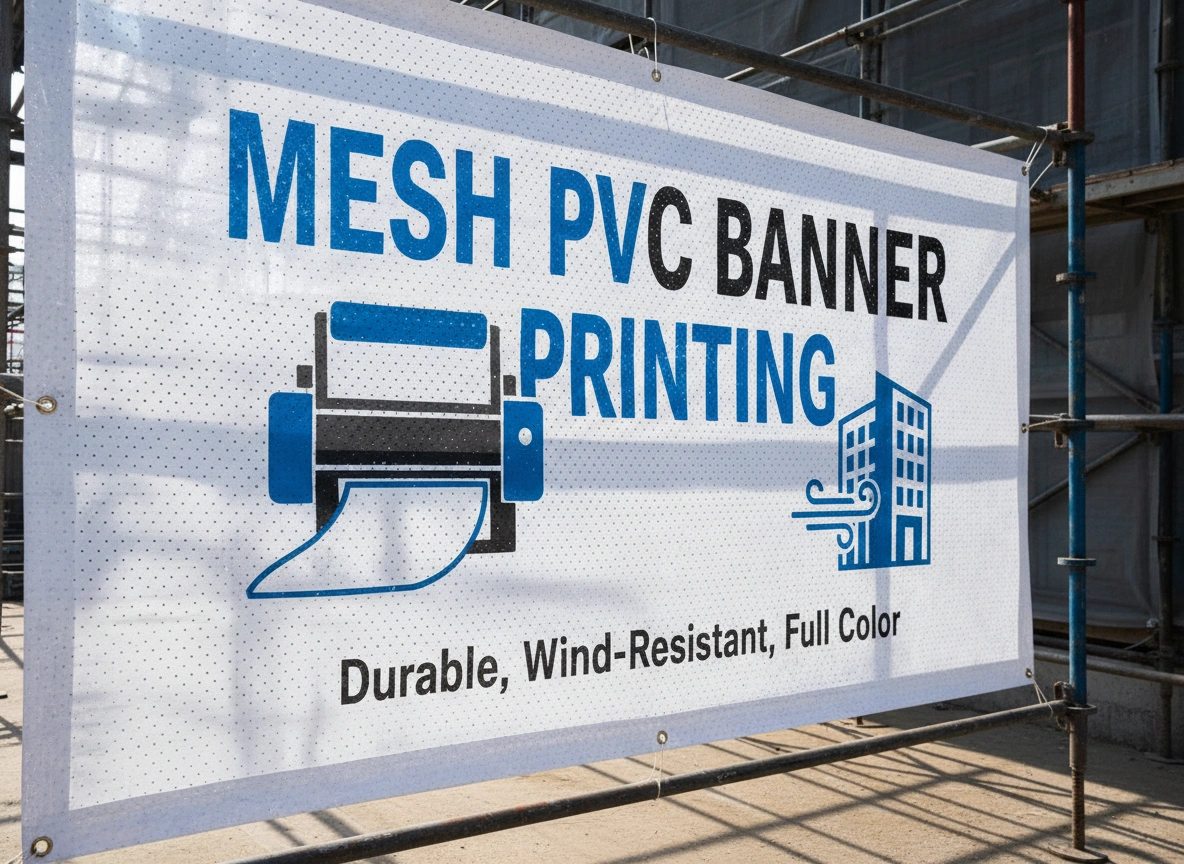
Mesh banner printing introduces controlled perforation across the banner surface. Those holes are not random. They are engineered to reduce wind load while retaining image legibility at distance.
Instead of acting like a sail, a mesh banner behaves more like a filter. Wind passes through it, reducing tension across the surface and relieving stress on fixings.
This is why mesh PVC banners are standard on construction sites, scaffolding, roadside fencing, and exposed elevations across the UK.
The Visual Trade-Off (and Why It’s Often Overestimated)
Mesh banners do reduce image density slightly. Up close, you can see the perforation. From typical viewing distances — across a road, behind barriers, above street level — that loss is largely irrelevant.
Modern large format printing compensates through ink density and contrast management. The real-world difference in legibility is far smaller than many buyers expect.
PVC vs Mesh in Real UK Installations
The decision between PVC and mesh should be driven by exposure, not preference.
PVC Banners Perform Best When:
-
Installed in sheltered or semi-sheltered locations
-
Used for short to medium durations
-
Visual impact and colour density are priorities
-
Wind load is low or intermittent
Mesh Banners Perform Best When:
-
Installed in open or elevated environments
-
Fixed to scaffolding, fencing, or temporary structures
-
Exposed to consistent or unpredictable wind
-
Safety, longevity, and compliance matter more than surface smoothness
Choosing PVC for a high-wind location does not fail immediately. It fails later, when fixings fatigue, hems weaken, and corners begin to tear.
Wind Load Is the Deciding Factor Most Buyers Ignore
Wind does not apply uniform pressure. It creates turbulence, lift, and vibration. Solid banners amplify these forces. Mesh banners dissipate them.
This is why many UK construction sites now specify mesh banners by default, not because they look better, but because they reduce risk.
Local authorities, site managers, and insurers increasingly expect airflow management in temporary signage. In some cases, solid banners are actively discouraged on exposed scaffolding.
Durability, Lifespan, and Maintenance Reality
No banner is permanent. All banners are consumables. The difference lies in how predictably they age.
Typical Outdoor Lifespan Expectations in the UK
| Banner Type | Typical Outdoor Lifespan | Common Use Case |
| Standard PVC Banner | 6–12 months | Retail, events, promotions |
| Mesh PVC Banner | 9–18 months | Construction, fencing |
| Heavy-Duty PVC Banner | 18–36 months | Long-term outdoor branding |
Actual lifespan depends on installation quality, wind exposure, and handling. A poorly tensioned mesh banner will still fail early. A well-installed PVC banner in a sheltered area can outperform expectations.
Material choice reduces risk — it does not replace good installation.
Print Quality and Viewing Distance: The Practical Reality
One of the most common misconceptions is that mesh banners “look worse”.
They do not — when specified correctly.
Mesh banners are almost always viewed from further away. Their intended viewing distance aligns naturally with their material characteristics. PVC banners are often used closer to eye level, where surface smoothness matters more.
Professional printers adjust resolution and ink laydown accordingly. Over-specifying resolution on mesh is wasteful. Under-specifying contrast is costly.
Good banner printing adapts to how banners are actually seen, not how they look on a screen.
Finishing: Where PVC and Mesh Win or Lose
Material choice means little without proper finishing.
Eyelet spacing, hem reinforcement, and edge welding matter more for PVC banners because the material carries higher load. Mesh banners still require disciplined finishing, but the reduced wind pressure gives them a wider margin for error.
Welded hems outperform stitched hems outdoors in almost every UK application. Water ingress weakens stitching over time. Welds remain intact.
Most banner failures occur at the edges, not the surface.
Environmental and Regulatory Considerations
PVC is not biodegradable. That fact is not disputed. What has changed is how responsibly it is managed.
Modern recyclable PVC banner substrates are now widely used in UK print production. Waste reduction, recovery schemes, and material reprocessing are becoming standard among professional suppliers.
PVC-free mesh alternatives exist and continue to improve. However, durability remains the limiting factor for long-term outdoor use. Many non-PVC meshes degrade faster under constant wind exposure, leading to more frequent replacement and higher overall material consumption.
For this reason, many organisations take a pragmatic approach: recyclable PVC that lasts longer, performs safely, and aligns with current procurement and regulatory expectations.
Choosing Between PVC and Mesh: A Practical Decision Framework
The correct question is not “Which is better?”
It is “Which fails less often in this environment?”
If a banner is exposed to wind, mesh reduces risk.
If a banner is sheltered and needs maximum visual impact, PVC makes sense.
Professionals choose material based on location, exposure, duration, and liability, not catalogue descriptions.
Final Perspective
In UK weather conditions, banners succeed or fail quietly. They rarely collapse dramatically. They simply age badly, loosen slowly, or tear at the corners when no one is watching.
Understanding the difference between PVC banner printing and mesh banner printing is not about preference. It is about recognising how materials behave once the job leaves the printer and meets the real world.
Done properly, both materials perform exceptionally well in the environments they were designed for.
That understanding is what separates banners that merely exist from banners that continue working long after installation.
If you want more information visit "I you Print".

 English
 Arabic
 French
 Spanish
 Portuguese
 Deutsch
 Turkish
 Dutch
Dutch
 Italiano
 Romaian
 Portuguese (Brazil)
 Greek
Greek