


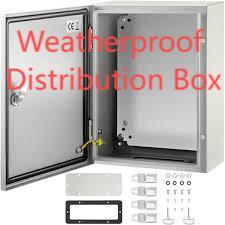
Selecting the right enclosure starts with real-world use cases, and a properly specified Weatherproof Distribution Box keeps field terminations dry, secure, and serviceable — choosing the wrong unit can create repeated maintenance cycles and equipment failures, so engineers must prioritize tested sealing systems and sensible internal layouts when specifying a Weatherproof Distribution Box for exposed installations. Early coordination between designers, installers, and operations teams avoids common pitfalls such as under-sized cable entries, insufficient ventilation, and incompatible mounting strategies that shorten equipment life.
Know the environment before you buy
Every outdoor site poses different challenges. Is the box exposed to salt-laden air, routine washdowns, or direct sunlight all day? Are there airborne chemicals nearby? These variables dictate choices like stainless hardware for coastal exposure, UV-stable polymers for rooftop installations, or higher IK ratings where mechanical impact is likely. A concise site survey that records rainfall direction, dust sources, and cleaning procedures helps define the enclosure specification and prevents costly retrofits.
Mechanical design and ingress protection essentials
Sealing performance is about more than a single gasket. Look for multi-lip gaskets designed to maintain compression after many access cycles, compression-controlled latches, and captive fasteners that won’t fall into equipment during service. Reinforced mounting bosses and backing plates prevent panel deformation when plugs are inserted or removed frequently. For critical systems, tamper-resistant hardware and lockable covers deter unauthorized access while preserving ingress protection.
Thermal management and component layout strategies
Heat is often overlooked until an overtemperature fault occurs. Place heat-generating devices on conductive mounting plates to draw heat away from terminals, and use reflective external finishes to reduce solar gain. For assemblies with significant dissipation, consider thermostatically controlled vents or low-power fans that maintain IP rating when closed. Thoughtful internal segregation—separating feeders from delicate electronics—reduces hotspot formation and simplifies future upgrades.
Nante PowerGuard Series: modularity for field adaptability
The Nante PowerGuard Series demonstrates how modular interiors simplify maintenance and expansion. Plug-in trays for surge arresters, metering, or monitoring modules allow upgrades without exposing the main wiring compartment. Removable gland plates and split-entry solutions make adding cables in the field straightforward while preserving seals. Standardized mounting patterns across the series reduce spare-part complexity and speed technician replacement tasks.
Cable entry, strain relief, and long-term sealing tactics
A box’s weatherproofing is only as good as its cable entries. Use correctly sized cable glands with appropriate torque settings, and prefer split-entry glands where future additions are likely. Incorporate strain relief and enforce generous bend radii to avoid conductor fatigue at terminations. Document approved field-modification procedures so technicians avoid ad-hoc drilling that compromises ratings. Multi-lip seals and compression latches maintain consistent seals through many access cycles.
Testing, certification, and procurement due diligence
Don’t accept nominal IP or IK numbers without test evidence. Request lab reports for ingress, impact, salt-spray, and UV-aging relevant to the model and production batch. Thermal-rise data under expected loads is essential for verifying operating safety. Provide installers with CAD files, torque specifications, and wiring templates to reduce onsite errors. Batch traceability and serialized labels speed warranty claims and fleet management for large deployments.
Maintenance planning and lifecycle cost savings
Plan gasket replacement intervals, store spare fasteners and common glands, and maintain a small stock of modular trays to minimize downtime. Replace consumables proactively rather than reacting to failures. Design choices that favor repairability—replaceable seals, standardized fasteners, and modular internals—reduce waste and lower total cost of ownership over the enclosure’s service life.
Installation tips and common mistakes to avoid
Mount on rigid, flat surfaces to avoid flange deformation; verify gland torque after thermal cycling; separate high-current conductors from sensitive control cables to reduce heating and EMI; and avoid field drilling when possible. Regular post-storm inspections reveal early seal degradation before it becomes a failure.
A thoughtfully engineered Weatherproof Distribution Box combines robust materials, tested sealing, and service-oriented features to protect outdoor electrical systems and reduce lifecycle costs. For specifications, accessories, and distributor information, visit https://www.nante.com/news/industry-news/weatherproof-distribution-boxes-features-applications-future-trends-and-more.html

 English
 Arabic
 French
 Spanish
 Portuguese
 Turkish
 Dutch
Dutch
 Italiano
 Russian
 Romaian
 Portuguese (Brazil)
 Greek
Greek