


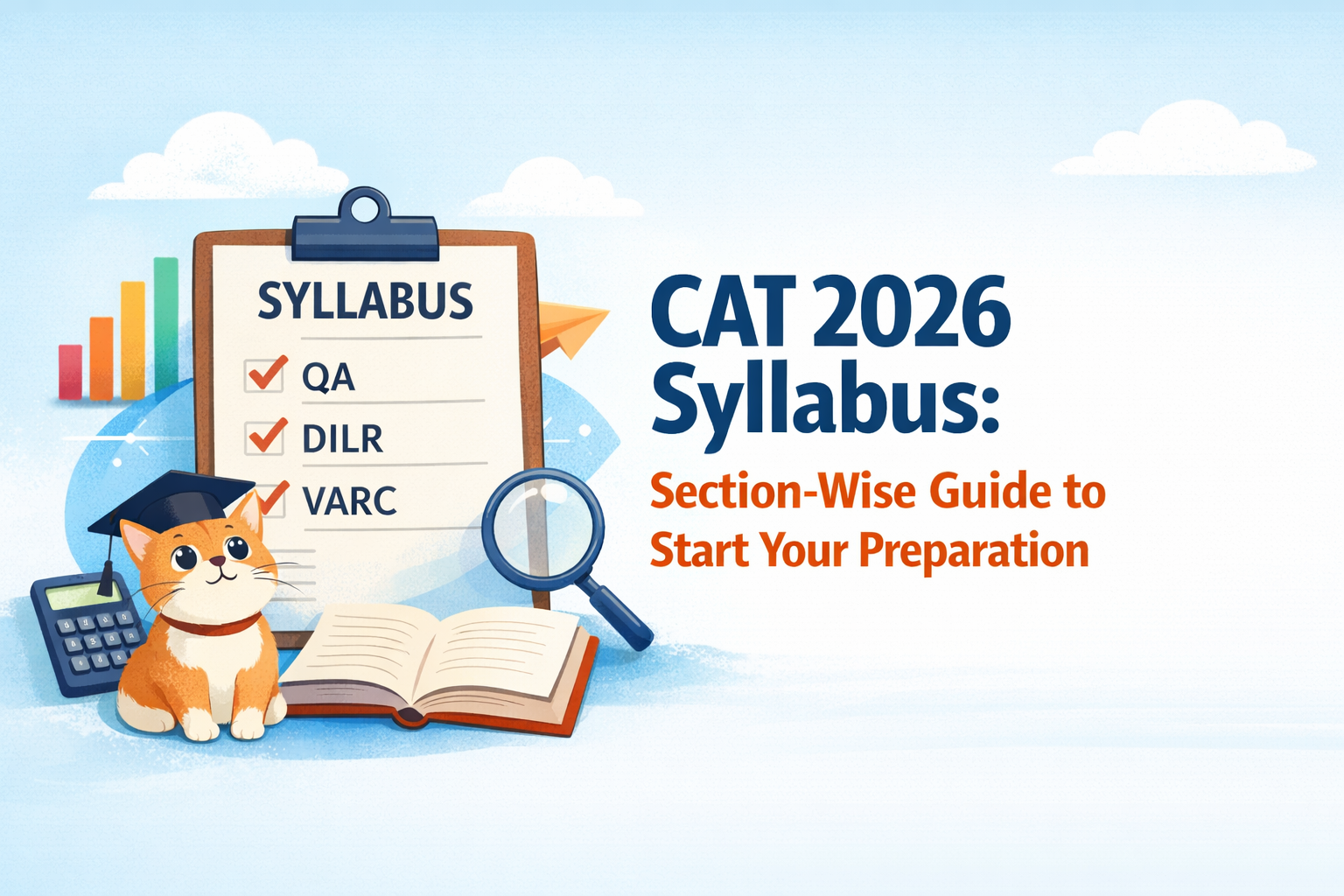
Preparing for CAT 2026 without understanding the syllabus is like starting a journey without a map. The Common Admission Test is one of the most competitive MBA entrance exams in India, and success depends on strategic preparation rather than random practice.
The CAT exam consists of three sections: Verbal Ability and Reading Comprehension (VARC), Data Interpretation and Logical Reasoning (DILR), and Quantitative Aptitude (QA). Each section has a fixed time limit, which makes sectional strategy extremely important.
VARC primarily focuses on Reading Comprehension passages along with Para Jumbles, Summary questions, and sentence-based problems. Since reading comprehension carries major weightage, improving reading speed and comprehension skills should be a daily habit.
DILR tests logical thinking and analytical ability. Questions are usually presented in the form of sets, including puzzles, seating arrangements, charts, graphs, and caselets. Instead of preparing topic-wise, candidates should practice complete sets to simulate the real exam environment.
Quantitative Aptitude includes topics from Arithmetic, Algebra, Geometry, Modern Math, and Number System. Most questions are based on fundamental mathematics up to Class 10 level, but they require strong conceptual clarity and application skills.
Before diving deep into preparation, aspirants should carefully review the complete CAT 2026 syllabus and understand which areas require more focus. Planning your study schedule according to topic weightage and difficulty level can significantly improve your performance.
A disciplined approach, regular mock tests, and consistent revision will increase your chances of achieving a high percentile in CAT 2026.

 English
 Arabic
 French
 Spanish
 Portuguese
 Deutsch
 Turkish
 Dutch
Dutch
 Italiano
 Russian
 Romaian
 Greek
Greek