


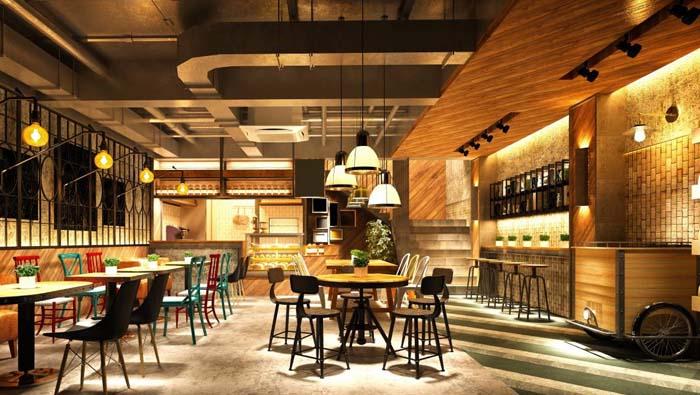
A commercial interior in the food and beverage sector is not an artistic project but a financial strategy. The physical layout of a venue directly dictates the speed of service, the average transaction value, and the long term maintenance costs. A specialized Cafe & Restaurant Interior Designer in India understands that profitability begins with the invisible infrastructure of the space. SKF Decor Pvt. Ltd. has observed that many hospitality ventures struggle because the design prioritizes aesthetics over operational flow. A professional tactic would mean that the kitchen, the bar, and the seating areas are all efficiently planned to co, ordinate the guests' journey through the establishment without any bottlenecks. By seeing the floor plan as a revenue, generating machine, a proprietor not only safeguards their investment but also lays a solid groundwork for quick expansion.
Spatial Engineering for Maximum Table Turnover
The primary goal of a high traffic cafe is to maximize seating capacity without making the guest feel crowded. A designer must calculate the exact clearance needed for staff to move with trays while guests are seated back to back. If the circulation paths are too narrow, the service slows down and the risk of accidents increases. Proper zoning also involves managing the acoustic environment so that the room feels energetic rather than chaotic. When the noise level is controlled through clever material selection, guests stay long enough to order dessert but not so long that they block the next seating. This balance is critical for maintaining a healthy daily revenue stream.
-
Dynamic Traffic Mapping: Designing the entrance and the billing counter to prevent crowds from blocking the path of the serving staff.
-
Acoustic Management Strategy: Installing soft ceiling baffles and textured wall panels to reduce the noise of cutlery and loud talking.
-
Service Triangles: Locating the bar, the kitchen exit, and the POS stations in such a way that the server's steps per order are minimized.
-
Climate Control Efficiency: Planning location of the air conditioning vents in such a way that a consistent temperature is maintained which does not cool the food prematurely
Technical Resilience and Hygiene Standards
A restaurant in the Indian market faces unique environmental challenges including high humidity and heavy dust. A Restaurant Interior Designer in India must select materials that can withstand rigorous daily cleaning with industrial chemicals without losing their visual appeal. This means looking past the surface to evaluate the slip resistance of the floors and the fire rating of the fabrics. A professional design also addresses the critical "unseen" areas such as the grease traps in the kitchen and the ventilation in the washrooms. When these technical layers are handled with precision during the build, the business avoids the costly shutdowns and repairs that usually plague poorly planned venues within the first year of operation.
The ROI of Professional Site Management
Launching a profitable space is a race against the clock because every day of construction is a day without revenue. A professional designer manages the various vendors and contractors to ensure that the plumbing, electrical, and aesthetic works happen in the correct sequence. This oversight prevents the common errors that lead to expensive rework, such as placing a light fixture where a kitchen vent needs to go. By acting as a technical gatekeeper, the designer ensures that the project stays on schedule and that the final build is a high performance environment that is ready for business on the day the doors open.
Scaling the Logic for the Lodging Industry
When a hospitality brand moves into the lodging sector, the design requirements become even more complex as the space must function twenty four hours a day. The most effective Hotel Interior Designers in India focus on the intersection of guest privacy and service efficiency. Much like a high end restaurant, a hotel needs a master plan that organizes the movement of hundreds of people. The objective is to establish such an efficient milieu where the guest is never to see the backstage of the operation and thus the guest gets a first, class experience that is worth the elevated room rates.
-
Back of House Integration: Designing hidden elevators and service paths so that laundry and waste management remain invisible to the guests.
-
Acoustic and Thermal Barriers: Implementing high grade window glazing and wall insulation to keep the outside noise and heat out of the guest rooms.
-
Mechanical Infrastructure Planning: Designing the ceiling cavities to house complex HVAC and plumbing systems without reducing the architectural height.
-
Commercial Grade Material Selection: Using stones and treated timbers that look better as they age and can handle constant heavy maintenance.
Building a Reliable Brand Destination
Ultimately, the physical space is the most tangible representation of the brand’s promise to the customer. It should communicate quality, hygiene, and stability from the very first glance. SKF Decor Pvt. Ltd. recognizes that in a competitive market, a well designed interior is a significant competitive advantage. By focusing on the structural integrity of the build and the efficiency of the layout, owners can create a destination that stands out for its professionalism. When a hospitality project is handled with this level of technical honesty, it ceases to be just a place of business and becomes a landmark that people value and return to for years.

 Arabic
 French
 Spanish
 Portuguese
 Deutsch
 Turkish
 Dutch
Dutch
 Italiano
 Russian
 Romaian
 Portuguese (Brazil)
 Greek
Greek