


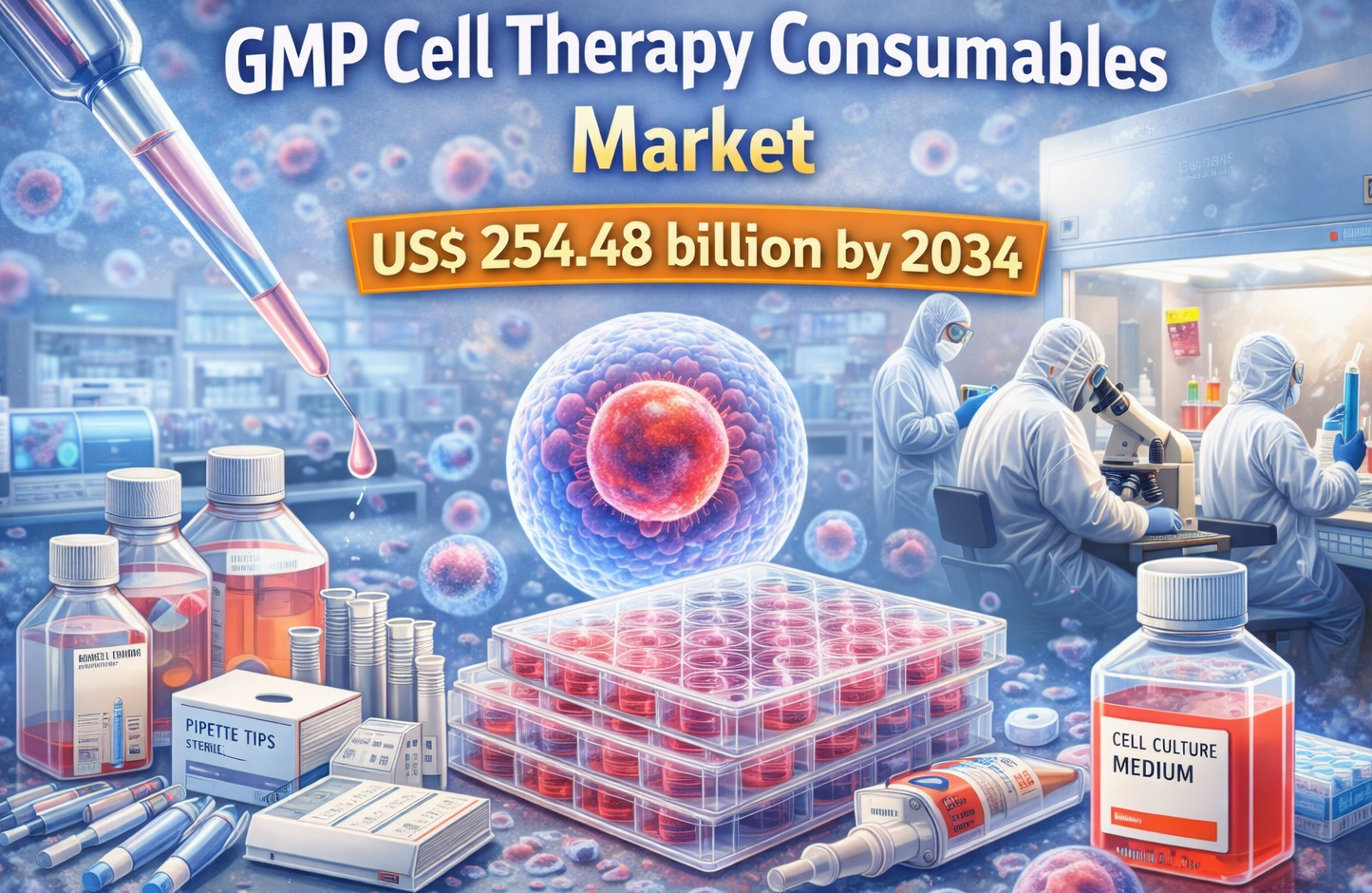
GMP (Good Manufacturing Practice) cell therapy consumables are specialized, single-use materials and reagents designed to meet stringent GMP standards. These consumables play a critical role in the production, processing, and storage of cell-based therapies, ensuring sterility, safety, and regulatory compliance in both clinical and commercial settings. They include kits, reagents, growth factors, cytokines, interleukins, and other essential single-use systems that maintain the quality and efficacy of cell therapies throughout all stages of research, development, and manufacturing.
GMP Cell Therapy Consumables Market Insights
The GMP cell therapy consumables market is poised for significant expansion in the coming years. The market is expected to grow from US$ 28.97 billion in 2025 to US$ 254.48 billion by 2034, representing a strong CAGR of 27.31% during the forecast period of 2026–2034. This rapid growth is driven by the increasing adoption of cell and gene therapies, rising demand for high-quality, compliant consumables, and technological advancements in automated and closed-system manufacturing platforms.
The growing pipeline of cell therapies particularly CAR-T, NK cell, T-cell, and stem cell therapies combined with a surge in clinical trials, is creating heightened demand for GMP-grade consumables. Manufacturers are focusing on standardized and traceable materials to ensure regulatory compliance, minimize contamination risks, and support scalability for commercial production.
Key Market Drivers
- Expanding Cell and Gene Therapy Pipeline: A growing number of candidates for CAR-T, NK cell, T-cell, and stem cell therapies are advancing to clinical trials, driving the need for high-quality consumables.
- Regulatory Compliance and Standardization: Global regulatory standards require GMP-certified consumables to ensure patient safety, product consistency, and traceability.
- Rising Prevalence of Chronic and Genetic Diseases: Increasing incidence of cancer, cardiovascular, and neurological disorders is driving investment in innovative cell-based treatments.
Market Opportunities
- Single-Use and Closed-System Technologies: Disposable, closed-system consumables reduce cleaning validation requirements, minimize contamination risks, and support scalable manufacturing processes.
- Specialized, Defined Media: Custom serum-free and xeno-free media optimize the expansion of specific cell types while meeting ethical and regulatory standards.
- Emerging Markets and CDMO Expansion: Developing regions and the growing reliance on Contract Development and Manufacturing Organizations (CDMOs) provide new opportunities for suppliers.
Download PDF Copy- https://www.theinsightpartners.com/sample/TIPRE00029780
Market Segmentation
- By Product: Kits, Reagents/Molecular Biology Reagents, Growth Factors/Cytokines and Interleukins
- By Cell Therapy: NK Cell Therapy, Stem Cell Therapy, T-Cell Therapy
- By Process: Cell Collection and Characterization, Cell Culture and Expansion, Cryopreservation, Cell Processing and Formulation, Cell Isolation and Activation, Cell Distribution and Handling, Process Monitoring and Control, Readministration, Quality Assurance
- By End User: Clinical, Commercial, Research
- By Geography: North America, Europe, Asia-Pacific, South & Central America, Middle East & Africa
Key Players
- Sartorius AG
- Thermo Fisher Scientific Inc
- Miltenyi Biotec BV & Co KG
- Bio-Techne Corp
- Corning Inc
- FUJIFILM Irvine Scientific Inc
- Lonza Group AG
- BPS Bioscience Inc
- Merck KGaA
The GMP cell therapy consumables market is moderately consolidated, with large multinational life science companies coexisting alongside specialized niche players. Companies are increasingly differentiating themselves through advanced, automated platform compatibility, defined and xeno-free media, and robust, traceable supply chains. Recent developments, such as Sartorius expanding production in France and Bio-Techne launching its ProPak™ GMP cytokines, reflect the ongoing efforts to meet growing global demand.
Future Outlook
The GMP cell therapy consumables market is expected to maintain a strong growth trajectory, fueled by the expansion of personalized medicine and regenerative therapies. Innovations such as AI-driven process monitoring, integrated automation, and advanced cryopreservation solutions will enhance production efficiency and scalability. Emerging markets will become increasingly important for expanding access, while partnerships with CDMOs will strengthen global supply chains. Overall, the market is set to become more standardized, sophisticated, and globally accessible, supporting safer and more effective cell-based therapies worldwide.
Related Reports-

 Arabic
 French
 Spanish
 Portuguese
 Deutsch
 Turkish
 Dutch
Dutch
 Italiano
 Russian
 Romaian
 Portuguese (Brazil)
 Greek
Greek