


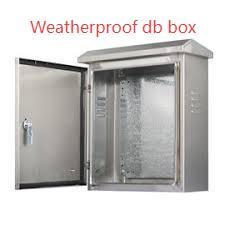
Choosing the right enclosure for outdoor electrical systems is about more than looks — it's about safety and service life. On many sites, a Weatherproof db box provides the guarded environment needed to keep breakers, busbars, and wiring safe from rain and dust, while still allowing technicians convenient access. In exposed locations, installing a Weatherproof db box early in the planning stage reduces downtime and protects downstream equipment from moisture-related failures.
Why weather resistance matters
Moisture, salt spray, wind-driven dust, and UV exposure all shorten the useful life of electrical components. Enclosures designed to block ingress and ventilate appropriately prevent corrosion, shorts, and nuisance trips. A well-chosen outdoor box preserves insulation integrity and keeps labeling and terminal connections readable — which matters for both safety inspections and trouble-shooting.
Materials and construction that endure
Metals such as powder-coated steel and stainless steel offer strength and corrosion resistance; polycarbonate and fiberglass-reinforced plastics (FRP) are excellent for non-conductive, lightweight installations. Look for seamless seams, reinforced hinges, and gasketing that compresses uniformly around doors. A good enclosure will include provisions for gland plates, knockouts, and internal mounting rails so the finished installation looks professional and performs reliably.
Installation best practices
Mount the enclosure where it won’t trap water — slightly sloped or under a small awning helps. Use corrosion-resistant fasteners and appropriate sealing compounds where conduits penetrate. Maintain recommended clearances for heat dissipation: overcrowding an enclosure with devices or running high-current conductors without ventilation will cause overheating and unnecessary wear. Always follow local electrical codes and manufacturer torque specifications when making terminations.
Maintenance and longevity tips
Routine checks extend life: inspect gaskets for compression and cracking, clear vents and weep holes of debris, and test closures for proper seal compression. Replace corroded fasteners and touch up coatings where scratches occur. For coastal or chemically aggressive environments, increase inspection frequency and consider sacrificial anodes or upgraded materials where necessary. Simple preventative maintenance reduces emergency repairs and extends warranty life.
Sizing, accessories, and thoughtful choices
Select an enclosure sized to allow wiring bends and future expansion. Internal DIN rails, removable mounting plates, and padlockable handles improve serviceability and security. Consider integrated surge protection devices and space for future communication modules. If the application requires visibility of meters or indicators, choose versions with lockable, transparent windows rated for impact and UV resistance.
In summary, investing in the right outdoor electrical enclosure reduces operational risk and maintenance costs. Proper specification — considering materials, ingress protection, ventilation, and mounting — results in installations that are safe, durable, and easy to service. For product options, specifications, and to find a model suited to your site, visit the detailed product page at https://www.nante.com/product/

 Arabic
 French
 Spanish
 Portuguese
 Deutsch
 Turkish
 Dutch
Dutch
 Italiano
 Russian
 Romaian
 Portuguese (Brazil)
 Greek
Greek