


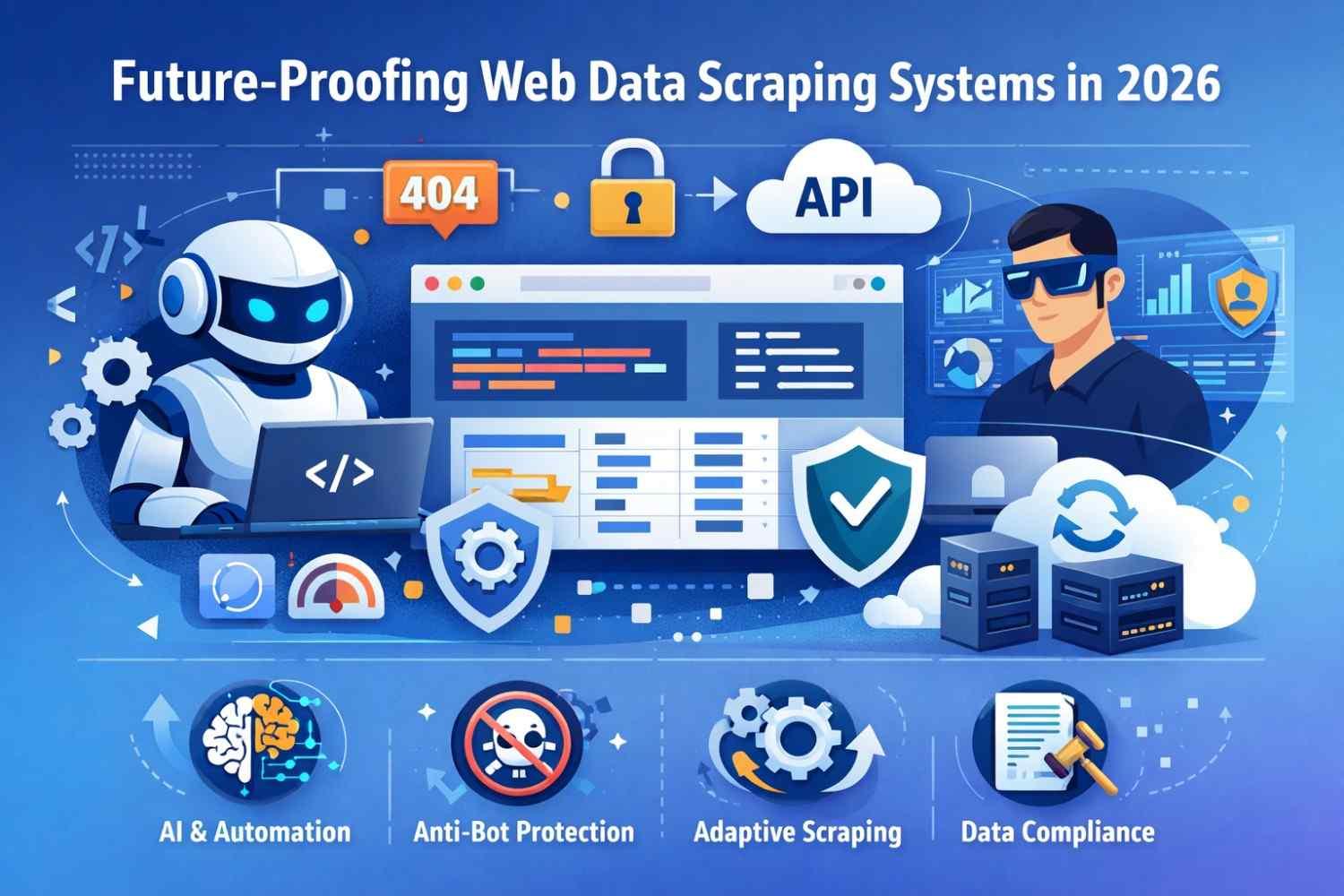
Future-Proofing Web Data Scraping Systems in 2026 is not just a technical ambition it is a survival instinct. We have watched scraping systems age the way milk does, not wine. What worked smoothly last quarter suddenly breaks after a minor website update usually at midnight, naturally. As we move toward 2026, businesses are no longer asking whether scraping is needed, but whether their systems can keep up without constant firefighting. The web is changing faster, compliance expectations are tighter, and data consumers want answers yesterday. So, instead of reacting to breakages, we believe it is time to design systems that expect change, welcome it, and quietly adapt without drama, panic, or emergency patches.
The State of Web Data Scraping Entering 2026
The scraping landscape entering 2026 feels more guarded, more dynamic, and far less forgiving. Websites are smarter, defenses are layered, and static HTML pages are becoming rare sightings. We see more JavaScript-heavy interfaces, dynamic loading, and region-aware content. At the same time, enterprises demand higher data accuracy and faster delivery. The gap between “quick script” and “production-grade system” has widened significantly. What once passed as acceptable now struggles under scale. And yes, adding more proxies is no longer a strategy—it is a temporary illusion. The reality is simple: scraping today requires architectural thinking, not clever shortcuts.
Why Traditional Scraping Architectures Quietly Fail
Traditional scraping systems usually fail politely at first. A missing field here, a delayed job there. Then one morning, everything stops. We have seen monolithic scrapers tightly coupled to page structures collapse when a single div changes its class name. These systems often lack visibility, modularity, and recovery paths. Maintenance becomes reactive, costly, and exhausting. The irony is that they often worked “perfectly” for years—until they didn’t. In 2026, quiet failure is no longer acceptable. Systems must be designed to isolate change, detect anomalies early, and degrade gracefully instead of falling apart all at once.
Designing Scraping Systems That Age Gracefully
A future-proof scraping system should age like a well-maintained machine, not an abandoned one. We focus on modular design—separating extraction logic, parsing rules, validation, and delivery. This separation allows teams to update one layer without destabilizing the entire pipeline. Flexibility matters more than clever tricks. A system that is slightly slower but adaptable will always outperform a fragile speed demon. We have learned that boring architecture is often the most reliable. When systems are predictable, teams stay calm, fixes are faster, and growth becomes manageable instead of stressful.
Handling Anti-Bot Measures Without Playing Whack-a-Mole
Anti-bot defenses are not personal, even when they feel that way. Modern websites analyze behavior, timing, and navigation patterns—not just IP addresses. We avoid whack-a-mole tactics and instead focus on human-like interaction flows, realistic request pacing, and ethical access patterns. Scraping systems that behave responsibly tend to last longer. There is also a business advantage here: fewer blocks mean lower operational noise. Fighting defenses aggressively often escalates the problem. Designing systems that blend in naturally is not about deception—it is about respecting how modern websites expect users to behave.
Scalable Infrastructure for Enterprise Scraping
Scalability is not about volume alone; it is about control. We build scraping infrastructures that scale horizontally, using queue-based workloads and cloud-native deployment patterns. This allows traffic to grow without overwhelming systems—or teams. Stateless workers, centralized monitoring, and fault isolation become essential at scale. Enterprises need predictable performance, not surprise bottlenecks. A scalable system should absorb spikes, recover automatically, and continue operating without manual intervention. When infrastructure scales smoothly, developers focus on improvements instead of emergencies, which is always a good trade.
When Real Time Data Extraction Actually Makes Sense
Real Time Data Extraction sounds impressive, but it is not always necessary. We recommend it only when timing directly impacts decisions—pricing intelligence, availability tracking, or rapid market signals. Real-time systems introduce complexity, cost, and operational pressure. For many use cases, near-real-time or scheduled extraction delivers equal value with less risk. The key is aligning speed with purpose. Faster is not always better. In fact, unnecessary urgency often reduces data quality. Choosing the right timing model future-proofs systems by balancing responsiveness with sustainability.
Data Quality, Validation, and Change Detection
Bad data is worse than no data, and it travels faster. We prioritize validation rules, schema checks, and automated change detection to ensure reliability. Websites change quietly—labels move, formats shift, optional fields disappear. Without detection, errors propagate downstream before anyone notices. Validation layers act as early warning systems. They catch anomalies before clients do (which is always preferable). High-quality data builds trust, and trust reduces friction. In future-proof systems, data accuracy is not an afterthought—it is a core design principle baked into every stage.
Compliance, Ethics, and Legal Readiness
Compliance is no longer optional, and shortcuts age poorly. We design scraping systems with respect for robots.txt, usage policies, and regional regulations. Ethical scraping aligns surprisingly well with long-term stability. Systems built responsibly face fewer disruptions and legal risks. In 2026, enterprises expect partners who understand compliance across geographies. Being legally prepared is not just about avoiding penalties—it is about maintaining operational continuity. Responsible design today prevents forced shutdowns tomorrow. Future-proofing means playing the long game, even when shortcuts look tempting.
Observability: Knowing When Things Break Before Clients Do
Observability is the difference between confidence and guesswork. We implement structured logging, health checks, and performance alerts that tell teams what is happening in real time. Silent failures are dangerous. A scraper that runs but delivers partial data is worse than one that stops. Metrics like success rates, response anomalies, and processing delays provide clarity. When teams see issues early, fixes are faster and calmer. Observability turns scraping from a black box into a manageable system—and that visibility becomes invaluable as scale increases.
AI and Automation in Modern Web Scraping
AI has become a helpful assistant, not a miracle cure. We use it for pattern recognition, selector adaptation, and anomaly detection. Self-healing parsers reduce manual maintenance, especially on frequently changing sites. That said, automation still needs boundaries. Blind reliance on AI introduces risk if outputs are not validated. The best systems combine automation with clear guardrails. Used responsibly, AI reduces repetitive work and improves resilience. Used carelessly, it creates silent errors. Balance is what keeps systems stable.
Preparing for Website Evolution, Not Just Website Changes
Websites are not just changing—they are evolving. API-driven content, personalized layouts, and region-based rendering are becoming standard. Scraping systems must adapt to this shift by supporting multiple extraction strategies. Flexibility matters more than optimization. We design systems that can pivot from DOM scraping to API integration when available. Preparing for evolution means expecting architectural shifts, not just cosmetic updates. Systems that anticipate change survive it with far less effort.
Building Scraping Systems That Teams Can Maintain
A system only lasts as long as the team that understands it. We emphasize documentation, clear ownership, and readable code. Scraping systems should not depend on one expert with tribal knowledge. Maintenance should be boring, predictable, and shared. When teams can onboard quickly and troubleshoot confidently, systems endure. Maintainability is often ignored during early success—and regretted later. In 2026, sustainable systems are team-friendly systems.
Cost Optimization Without Cutting Corners
Future-proofing also means controlling costs intelligently. Efficient scheduling, adaptive crawling frequency, and resource-aware scaling reduce waste. We avoid false economies—cheap infrastructure that fails under pressure becomes expensive fast. Cost optimization should support reliability, not undermine it. Well-designed systems spend where it matters and save where it does not. The goal is predictable spending, not minimum spending. Stability always wins in the long run.
Testing Strategies for Long-Term Reliability
Testing scraping systems requires more than unit tests. We implement regression tests against known page states and monitor output consistency. Sandbox environments allow safe experimentation. Continuous testing catches subtle changes before production impact. Testing is not a one-time activity; it is an ongoing discipline. Systems that are tested regularly adapt more smoothly to change. Reliability is built, not hoped for.
Deployment Pipelines That Support Change
Modern scraping systems benefit from CI/CD pipelines just like any other software. Controlled rollouts, versioned logic, and rollback mechanisms reduce deployment risk. We treat scraping updates as software releases, not quick fixes. This discipline improves confidence and reduces downtime. Pipelines make change predictable—and predictable change is the foundation of future-proof systems.
Client Expectations in 2026 and Beyond
Clients expect speed, accuracy, transparency, and accountability. They want to know when data updates, how reliable it is, and what happens when something changes. Scraping systems must support reporting and visibility, not just extraction. Meeting expectations consistently builds trust. In 2026, silence is interpreted as failure. Clear communication, supported by robust systems, becomes a competitive advantage.
Future Trends Shaping Web Data Scraping
Browser-level defenses, structured data standards, and smarter detection will continue to shape scraping. At the same time, demand for actionable insights will grow. The future favors adaptable systems over rigid tools. Trends will change, but principles remain: modularity, compliance, observability, and resilience. Systems built on these foundations will outlast trends.
Practical Checklist for Future-Proofing Today
Future-proofing starts now. Modular architecture, ethical access, monitoring, scalable infrastructure, and maintainable code form the core. Teams should review systems regularly and plan for change proactively. Small improvements compound over time. Waiting for failure is the most expensive strategy.
Conclusion
Future-proofing Web Data Scraping Systems in 2026 is not about predicting every change—it is about being ready for any of them. Systems that adapt calmly, recover quickly, and respect boundaries will always outperform fragile ones. We believe the future belongs to scraping systems that are built thoughtfully, maintained responsibly, and designed with tomorrow in mind. When the web changes—and it will—those systems will not panic. They will simply adjust and keep going.
FAQs
What makes a scraping system future-proof?
Adaptability, observability, compliance, and modular design.
How often should systems be reviewed?
Quarterly reviews help catch risks early.
Is real-time scraping always required?
No, only when timing directly impacts outcomes.
How do we handle frequent site changes?
Through validation, monitoring, and flexible extraction logic.
Does AI replace manual scraping logic?
No, it complements it when used carefully.
How can failures be detected early?
With strong monitoring and alerting systems.

 Arabic
 French
 Spanish
 Portuguese
 Deutsch
 Turkish
 Dutch
Dutch
 Italiano
 Russian
 Romaian
 Portuguese (Brazil)
 Greek
Greek