


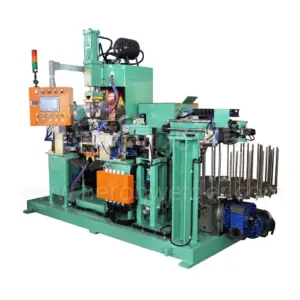
In modern manufacturing, achieving high-quality, reliable metal joints efficiently is critical. Projection welding has emerged as a preferred technique for joining components in automotive, aerospace, and industrial applications. Heron Welder, a global leader in industrial welding solutions, offers advanced projection welders designed to meet the demands of OEMs, automation integrators, and high-volume production facilities. In this guide, we explore the principles, applications, advantages, and best practices for projection welding, highlighting how Heron can help optimize your production processes.
What is a Projection Welder?
Projection welding is a type of resistance welding where a current is concentrated on small projections or raised points on one of the workpieces. These projections act as stress concentrators and fuse first, allowing multiple joints to be welded simultaneously. This method ensures precise, high-quality welds with minimal deformation of the base materials.
Unlike spot welding, which focuses on single points, projection welding is ideal for components with multiple weld locations. It is widely used in automotive assembly, electronic enclosures, and heavy industrial equipment.
How Does a Projection Welder Work?
A projection welder combines electrical resistance, heat generation, and mechanical pressure to form strong joints. The process involves the following steps:
-
Setup: The components to be welded are positioned, ensuring projections align with the welding electrodes.
-
Current Application: A high current passes through the projections, generating heat due to electrical resistance.
-
Fusion: Heat concentrates at the projections, causing localized melting while preserving the surrounding material.
-
Pressure Application: Mechanical pressure consolidates the weld nugget, ensuring uniform penetration and strong adhesion.
-
Cooling: The weld solidifies under pressure, creating a durable, consistent joint.
Heron projection welders are engineered for precision control of current, pressure, and timing, ensuring repeatable results across complex assemblies.
Applications of Projection Welding
Projection welding is highly versatile and widely used in industrial settings:
Automotive Manufacturing
-
Fastening brackets, nuts, and clips to sheet metal components.
-
Welding gear components, battery terminals, and structural elements.
Electrical and Electronics Industry
-
Joining busbars, connectors, and small electronic assemblies.
-
Ensuring minimal distortion in delicate components.
Heavy Machinery & Industrial Equipment
-
Fabrication of frames, panels, and metal housings.
-
Combining high-strength steels and alloys efficiently.
Heron’s projection welding machines can be integrated into automated production lines, enabling high-speed, multi-point welding ideal for high-volume manufacturing.
Advantages of Using a Projection Welder
High Precision & Quality
Concentrated heat ensures clean welds with minimal spatter and reduced deformation, critical for precision assemblies.
Multi-Point Welding Capability
Simultaneously weld multiple projections, increasing throughput and reducing cycle times.
Versatility
Handles a wide range of metals and thicknesses, including stainless steel, aluminum, and high-strength alloys.
Integration with Automation
Heron projection welders can be combined with robotic systems, conveyors, and automated feeders for fully automated production lines.
Projection Welder vs. Spot Welder
While both projection and spot welding are resistance-based techniques, their differences are notable:
| Feature | Projection Welder | Spot Welder |
|---|---|---|
| Weld Focus | On projections (raised points) | Single points of contact |
| Material Deformation | Minimal | Higher risk of warping |
| Multi-Point Capability | High | Limited |
| Applications | Automotive, industrial, electronics | Sheet metal assemblies, simple joints |
For complex assemblies with multiple attachment points, projection welding offers superior consistency and efficiency.
Best Practices for Projection Welding
To maximize performance and weld quality:
-
Proper Projection Design: Ensure projections are correctly sized and uniformly distributed.
-
Optimal Electrode Maintenance: Regularly inspect and dress electrodes to maintain precise current distribution.
-
Controlled Welding Parameters: Adjust current, force, and timing based on material thickness and type.
-
Automation Integration: Leverage Heron’s controllers and robotic interfaces for consistent, repeatable welding cycles.
-
Regular Quality Checks: Use non-destructive testing or destructive testing for critical assemblies to ensure weld integrity.
Heron’s projection welders come with advanced control systems and customizable parameters to simplify adherence to these best practices.
Why Choose Heron for Projection Welding Solutions?
Heron Welder is a trusted provider of industrial welding equipment, offering:
-
Full Range of Projection Welders: From manual to fully automated multi-point machines.
-
Customizable Solutions: Tailored to OEM and factory requirements.
-
Expert Technical Support: Assistance in integration, programming, and process optimization.
-
High Reliability: Robust machines built for continuous industrial operations.
With decades of experience, Heron helps factories increase production efficiency while maintaining exceptional weld quality.
Frequently Asked Questions (FAQs)
1. Can projection welding be used on aluminum?
Yes, with the right electrode material and machine settings, projection welding works efficiently on aluminum and aluminum alloys.
2. What industries benefit most from projection welding?
Automotive, electronics, aerospace, and heavy machinery sectors leverage projection welding for multi-point, high-quality joints.
3. How does projection welding differ from resistance seam welding?
Projection welding focuses on raised points for multi-point joints, while seam welding produces continuous welds along edges.
4. Can projection welders be integrated with robotics?
Absolutely. Heron machines are designed for seamless automation integration, improving consistency and cycle times.
5. What maintenance is required for projection welders?
Routine electrode inspection, cleaning, and calibration of welding parameters ensure optimal performance and weld quality.
Conclusion
Projection welding is a precise, efficient, and versatile joining method essential for modern manufacturing. By choosing Heron projection welders, OEMs, factory engineers, and automation integrators gain access to advanced, reliable equipment backed by technical expertise.
Optimize your production line, ensure superior weld quality, and enhance throughput. Contact Heron today to request a quote or consult with our experts for a customized welding solution tailored to your factory’s needs.

 Arabic
 French
 Spanish
 Portuguese
 Deutsch
 Turkish
 Dutch
Dutch
 Italiano
 Russian
 Romaian
 Portuguese (Brazil)
 Greek
Greek