


The explosive growth of data-intensive applications—from IoT and autonomous systems to AI workloads and real-time analytics—has brought the limitations of centralized cloud infrastructure into sharp focus. Latency-sensitive workloads can no longer rely solely on distant hyperscale data centers. Instead, organizations are increasingly turning to Edge Colocation facilities, which bring compute, storage, and networking resources closer to the point of data generation. As the digital world becomes more distributed, Edge Colocation is emerging as a core enabler of high-performance digital ecosystems.
According to QKS Group’s definition, Edge Colocation refers to distributed, geographically proximate data center facilities designed to minimize latency, increase bandwidth efficiency, improve data privacy, and support mission-critical real-time applications. These facilities act as regional or micro-edge nodes, enabling enterprises to host workloads closer to end users while offloading traffic from central clouds. The rise of Industry 4.0, connected vehicles, smart cities, streaming platforms, and immersive digital experiences further drives the demand for edge-centric architectures.
Click Here For More Information: https://qksgroup.com/market-research/spark-matrix-edge-colocation-q3-2024-8067
Why Edge Colocation Matters More Than Ever
The transition from centralized cloud architectures to distributed computing models is reshaping the digital infrastructure landscape. Organizations need faster processing, minimal latency, localized data governance, and uninterrupted service delivery.
Key drivers accelerating Edge Colocation adoption include:
1. Explosion of IoT and Machine Data
Sensors, industrial machines, and connected devices generate massive volumes of data that require immediate processing.
2. Real-Time Application Demands
Applications like autonomous vehicles, predictive maintenance, and AR/VR cannot tolerate cloud-induced delays.
3. Bandwidth Optimization
Offloading raw data to faraway data centers increases cost and congestion. Edge nodes reduce bandwidth strain.
4. Regulatory and Data Sovereignty Requirements
In industries like healthcare, government, and finance, data must remain within specific geographic boundaries.
5. Resilient and Distributed Digital Experiences
Enterprises need low-latency content delivery, uninterrupted service availability, and localized processing.
These drivers make Edge Colocation a foundational component in next-generation digital ecosystems.
What Makes Modern Edge Colocation Intelligent
The new wave of edge facilities is not simply smaller data centers—they are advanced, automated, and built for intelligent connectivity.
1. Low-Latency Infrastructure
Proximity-based deployments reduce round-trip time for apps requiring immediate responses.
2. High-Performance Interconnects
Edge facilities offer direct on-ramps to hyperscalers, telecom networks, and private clouds.
3. Modular and Scalable Designs
Prefabricated modules and micro-edge sites reduce deployment time and expand capacity on demand.
4. AI and Automation
AI-driven monitoring, energy optimization, and predictive maintenance are becoming standard features.
5. Compliance and Security
Edge sites incorporate localized compliance frameworks, zero-trust models, and real-time threat intelligence.
In essence, Edge Colocation transforms how enterprises deploy and manage digital workloads, making IT ecosystems faster, more reliable, and more distributed.
Download Sample Report Here: https://qksgroup.com/download-sample-form/%20?id=8067
The Evaluation Gap — Why Selecting an Edge Colocation Provider Is Challenging
While demand for Edge Colocation is rising, selecting the right provider remains difficult. Traditional data center assessments are not designed for distributed edge environments, leaving buyers with limited clarity.
QKS Group identifies several gaps in today’s evaluation landscape:
1. Highly Variable Deployment Scenarios
Edge needs differ radically across industries—manufacturing requires rugged micro-edge nodes, while gaming demands regional latency hubs. Generic rankings don’t capture this nuance.
2. Wide Differences in Architecture
Providers vary in:
- Interconnection density
- Partner ecosystems
- Proximity to fiber routes
- Sustainability features
- Regulatory infrastructure
These differences require context-based evaluation, not broad comparisons.
3. Lack of Real-World Deployment Data
Buyers need insights into:
- Actual uptime
- Operational resilience
- Real-world latency measurements
- Integration with telecom and cloud ecosystems
These are rarely available in standard reports.
4. Visibility Challenges for Niche Providers
Regional and specialized providers excel in certain markets but remain overshadowed by large global data center brands.
5. Need for Trust and Peer Validation
Infrastructure decisions involve long-term commitments. Buyers want trusted feedback from similar organizations deploying edge workloads.
These gaps highlight the need for an evaluation model that blends analyst-grade insight with proof from real-world users.
SPARK Plus™ — Bridging Analyst Research and Real Deployment Realities
To address the complexity of Edge Colocation evaluation, QKS Group developed SPARK Plus™, the industry’s first insight-led platform combining structured analyst commentary with verified user reviews. It transforms how buyers discover and benchmark edge infrastructure vendors.
How SPARK Plus™ Solves the Evaluation Problem
1. Contextual, Use-Case-Based Comparisons
Unlike traditional reports, SPARK Plus™ enables filtering by:
- Industry (manufacturing, gaming, telecom, retail, logistics, etc.)
- Deployment model (regional edge, micro-edge, managed edge)
- Geographic location
- Enterprise size
This ensures meaningful, context-rich comparisons.
2. Integration of Real-World Performance Data
The platform includes verified user feedback on:
- Latency performance
- Power reliability
- Security incidents
- Deployment speed
- SLA adherence
- Ease of integration
This gives buyers actionable insights into operational performance.
3. Transparent Analyst Commentary
SPARK Plus™ provides vendor-level and parameter-level analysis across:
- Interconnect capabilities
- Hardware density
- Sustainability metrics
- Compliance frameworks
- Scalability and design architecture
This brings clarity that traditional rankings lack.
4. Visibility for Specialized Edge Providers
Mid-market and regional colocation providers gain exposure where they excel, giving buyers more complete marketplace visibility.
Together, these features ensure that enterprises evaluating Edge Colocation options receive the most accurate, well-rounded intelligence available.
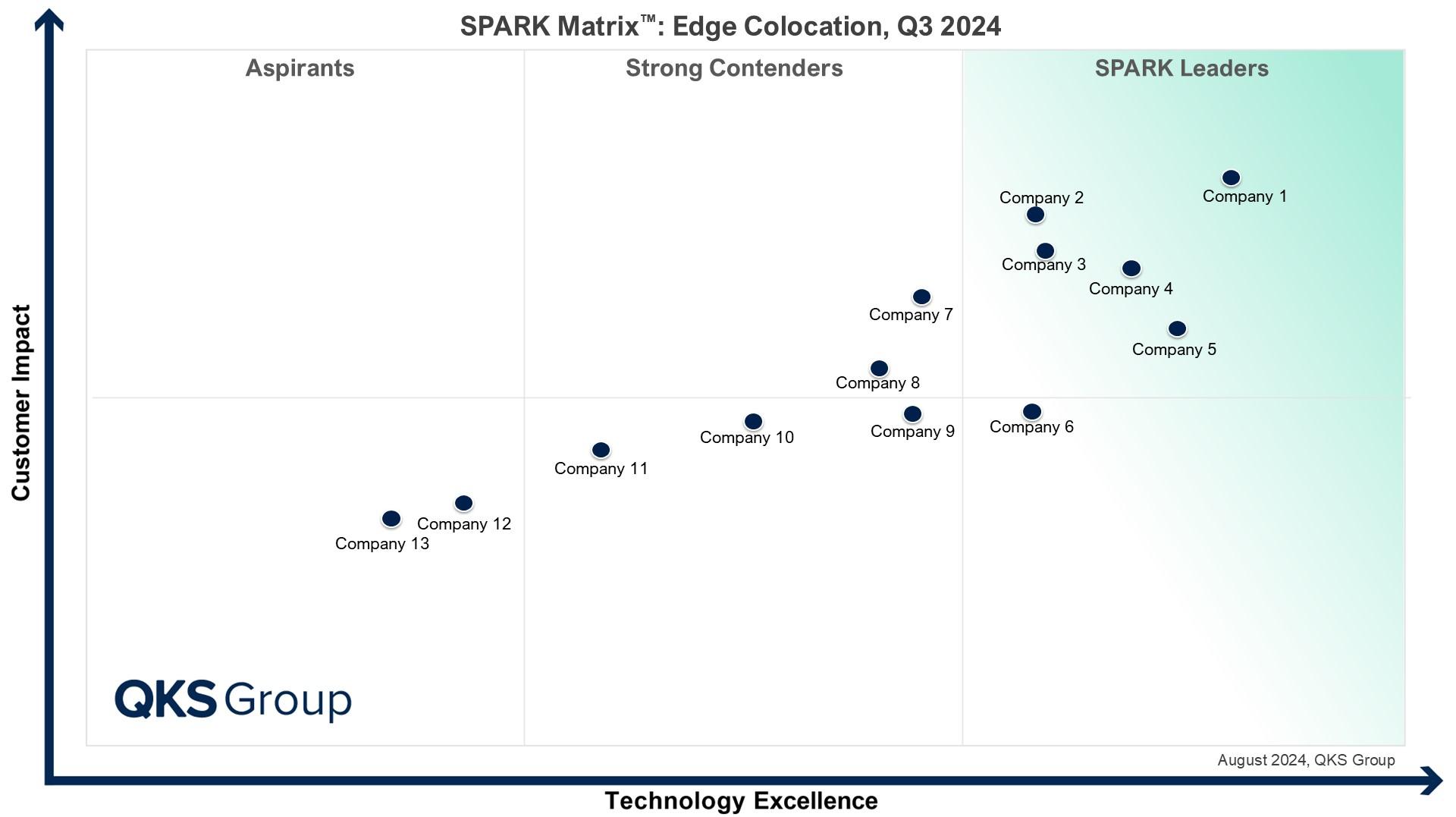
SPARK Matrix™ — Benchmarking Edge Colocation Providers
The SPARK Matrix™ evaluates vendors along two key dimensions:
- Technology Excellence
- Customer Impact
Each vendor is assessed on criteria such as:
- Interconnection ecosystem strength
- Edge readiness and coverage
- Redundancy and failover capabilities
- Sustainability and energy efficiency
- Security posture
- Scalability and modular design
- Deployment agility
These parameters help enterprises identify the most suitable providers for their edge strategy.
Become A Client: https://qksgroup.com/become-client
Conclusion
As enterprises embrace real-time analytics, automation, and intelligent digital services, Edge Colocation has become indispensable. It enhances performance, improves compliance, strengthens resilience, and reduces costs by bringing compute closer to the data source. Yet selecting the right provider remains a complex decision that requires deep contextual evaluation.
SPARK Plus™ by QKS Group closes this decision gap by uniting analyst insights with verified user experiences, enabling more confident, data-backed purchasing choices. Combined with SPARK Matrix™ benchmarking, the platform empowers enterprises to navigate the rapidly evolving edge infrastructure market with precision.
In a world where milliseconds matter, Edge Colocation—validated through SPARK Plus™—is set to shape the future of distributed digital infrastructure.

 English
 Arabic
 French
 Spanish
 Portuguese
 Deutsch
 Dutch
Dutch
 Italiano
 Russian
 Romaian
 Portuguese (Brazil)
 Greek
Greek