


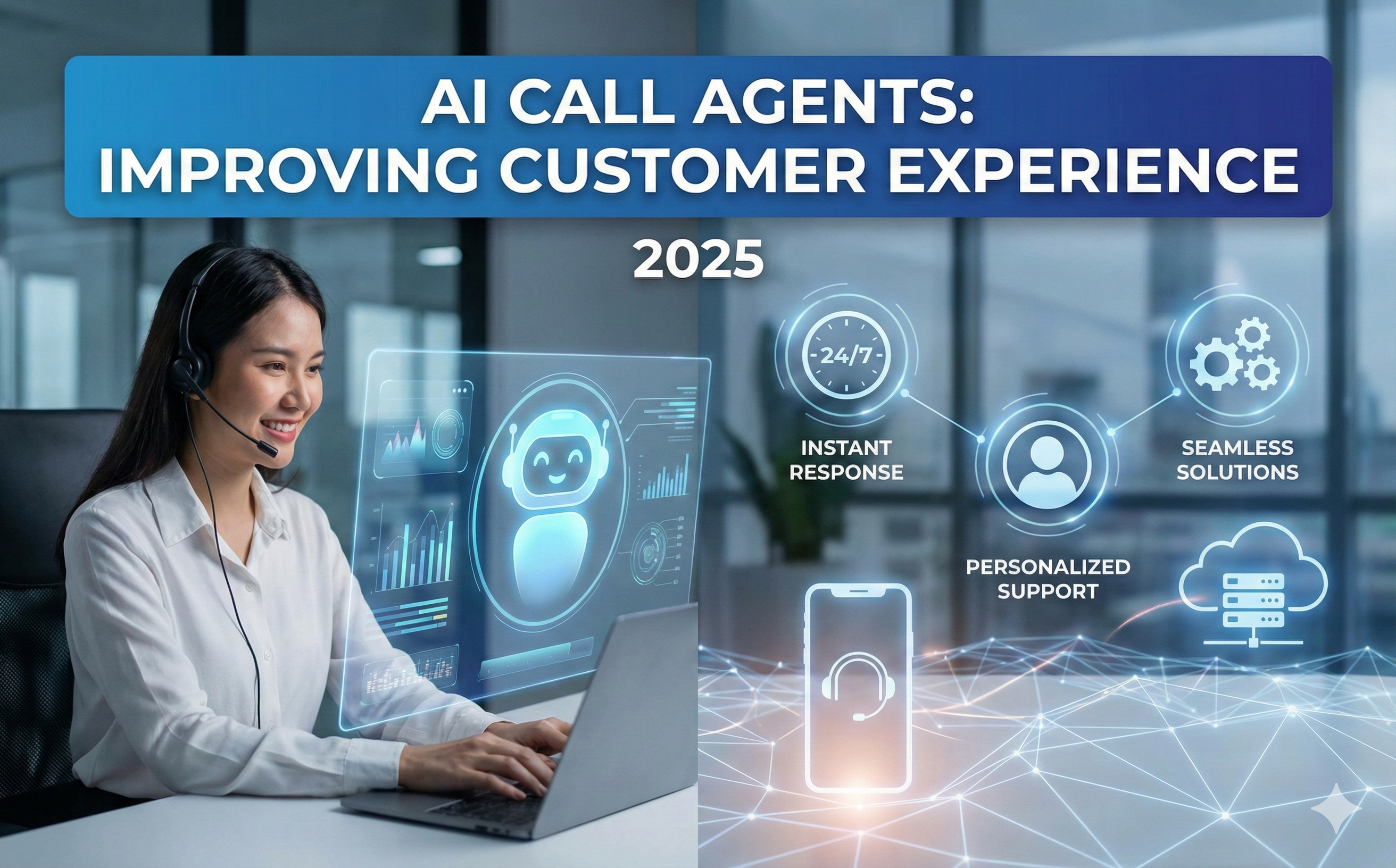
Customer service has entered a new era, one where AI voice agents are rapidly replacing the traditional support model built on human-led interactions, long wait times, and manual processes. In 2025, advanced conversational AI, natural language processing (NLP), and speech recognition have made AI voice agents more accurate, empathetic, and scalable than ever before.
Businesses across industries, e-commerce, healthcare, banking, travel, real estate, and SaaS, are adopting AI voice agents to deliver instant, personalized, 24/7 customer support while drastically reducing operational costs.
This blog explains how AI voice agents are transforming customer service in 2025, how they work, why businesses are adopting them, and what the future holds.
What Are AI Voice Agents?
An AI voice agent is a virtual assistant powered by artificial intelligence that interacts with users through voice-based communication.
These agents understand spoken language, analyze customer intent, and respond naturally, just like a trained human agent.
AI voice agents use advanced technologies:
-
Automatic Speech Recognition (ASR) to convert speech into text
-
Natural Language Processing (NLP) to understand meaning
-
Speech Synthesis (TTS) to generate human-like voice responses
-
Machine Learning (ML) to improve with each interaction
-
Real-time data retrieval to personalize responses
The result?
A fast, accurate, and scalable customer service experience.
Why AI Voice Agents Are Transforming Customer Service in 2025
1. Instant 24/7 Customer Support
Today’s customers expect immediate help, no waiting, no holding on the line.
AI voice agents operate round-the-clock, handling frequently asked questions, order updates, troubleshooting, and appointment scheduling without delay.
2. Human-like Conversations
In 2025, conversational AI has reached 95%+ accuracy in voice understanding.
AI voice agents now mimic natural tone, pauses, and context, making conversations feel genuinely human.
3. Massive Cost Reduction
AI voice agents can handle thousands of calls at once, replacing repetitive human tasks.
Businesses save 50–80% on customer support costs through automation.
4. Higher Customer Satisfaction
AI agents reduce:
-
Call waiting times
-
Ticket backlogs
-
Human errors
-
Customer frustration
With faster resolution and personalized service, satisfaction scores rise significantly.
5. Multilingual Support
Modern AI voice agents can speak 50+ languages fluently, helping brands serve global customers effortlessly.
6. Scalability Without Hiring More Staff
Whether it's 100 calls or 10,000 calls, AI voice agents handle everything without extra hiring, training, or salary expenses.
How AI Voice Agents Work (Step-by-Step)
1. Customer Speaks
The user asks a question or states a problem (e.g., “Where is my order?”).
2. Speech Recognition
The AI converts the spoken message into text using ASR.
3. NLP Understanding
The system detects the:
-
Intent
-
Keywords
-
Emotions
-
Context
4. Processing the Response
The AI checks internal databases like CRM, order history, or knowledge base.
5. Generate Voice Response
The agent converts the output into a natural-sounding voice reply.
6. Continuous Learning
Every interaction improves the AI through reinforcement learning.
Key Benefits of AI Voice Agents for Businesses
1. Reduce Customer Support Workload
AI voice agents automate up to 80% of routine queries, freeing human agents for complex tasks.
2. Improve First-Call Resolution (FCR)
AI voice agents instantly access customer history, improving resolution rates.
3. Consistent and Accurate Responses
Unlike humans, AI never gets tired, frustrated, or confused.
4. Reduce Burnout Among Human Agents
With repetitive tasks automated, employees handle only important cases.
5. Seamless Integration
AI voice agents integrate with:
-
CRMs
-
Helpdesk systems
-
IVR
-
E-commerce platforms
-
Inventory systems
-
Booking tools
6. Boost Sales & Conversions
AI voice agents can:
-
Upsell products
-
Recommend personalized items
-
Follow up with leads automatically
Top Use Cases of AI Voice Agents in 2025
1. Customer Support
Resolve queries like:
-
Refund status
-
Order tracking
-
Account updates
-
Product information
2. Appointment Scheduling
Healthcare, salons, clinics, and service centers use AI voice agents for:
-
Booking appointments
-
Rescheduling
-
Reminders
3. Lead Qualification
AI voice agents qualify leads by asking questions, determining intent, and scheduling demos or sales calls.
4. Automated Follow-ups
Voice agents automatically:
-
Remind about payments
-
Follow up on leads
-
Confirm orders
5. Emergency Assistance
Industries like insurance and utilities use AI voice agents for quick support during emergencies.
6. Voice-Based Payments
AI voice assistants now support secure payments using biometric voice authentication.
Industries Using AI Voice Agents in 2025
1. E-commerce
Automated order updates, product inquiries, returns, and delivery tracking.
2. Healthcare
Appointment booking, lab report updates, and medication reminders.
3. Banking & Finance
Balance inquiries, loan updates, and fraud detection alerts.
4. Real Estate
AI voice agents qualify buyers, schedule property tours, and answer FAQs.
5. Travel & Hospitality
Hotel booking, flight updates, itinerary changes.
6. Telecom
Plan upgrades, bill payments, and technical troubleshooting.
AI Voice Agents vs Traditional IVR Systems
| Feature | AI Voice Agent | Traditional IVR |
| Conversational | Yes, natural & human-like | No, button-based |
| Understanding | Context-aware | Limited |
| Personalization | High | Low |
| Multitasking | Supports complex queries | Only predefined flows |
| Engagement | High | Often frustrating |
| Support | 24/7 | Limited |
AI voice agents are the next evolution of IVR, smart, conversational, and customer-focused.
Future of AI Voice Agents in Customer Service (2025–2030)
1. Emotion AI & Sentiment Detection
AI voice agents will detect customer emotions and respond empathetically.
2. Hyper-Personalization
AI will analyze customer data in real time to provide customized solutions.
3. Voice Commerce
Customers will shop through voice agents using natural conversation.
4. Advanced Multilingual Conversations
Voice agents will switch languages mid-conversation based on user preference.
5. Autonomous Call Centers
AI will handle 95% of customer interactions without human intervention.
Challenges & Solutions
Challenge 1: Accents & Speech Clarity
Solution: AI models now support global accents with >95% accuracy.
Challenge 2: Customer Trust
Solution: Transparent AI policies, secure data handling.
Challenge 3: Complex Queries
Solution: Hybrid model AI handles simple queries; humans handle escalations.
Challenge 4: Integration Difficulties
Solution: Plug-and-play APIs from modern AI platforms.
Why AI Voice Agents Are Essential in 2025
-
Customers expect fast, accurate service.
-
Businesses must reduce operational costs.
-
AI provides scalability without hiring.
-
Voice interfaces are becoming mainstream.
-
AI voice agents create better, more satisfying interactions.
AI voice agents are no longer a luxury; they’re a must-have for modern customer service.
Conclusion
AI voice agents are transforming customer service in 2025 by delivering instant support, reducing costs, and offering personalized, human-like conversations at scale. With advancements in NLP, conversational AI, and automation, businesses that adopt AI voice agents gain a significant competitive advantage.
As industries evolve, AI voice agents will continue to innovate and reshape how brands and customers communicate.
Frequently Asked Questions (FAQs)
1. Are AI voice agents better than human customer support?
They complement, not replace, human agents by handling repetitive tasks.
2. Can AI voice agents handle multiple languages?
Yes, modern agents support 30 50+ languages.
3. Do AI voice agents reduce customer service costs?
Absolutely. Most companies save between 50–80% annually.
4. Are AI voice agents secure?
Yes, with encryption, authentication, and compliance frameworks.
5. Which businesses should use AI voice agents?
E-commerce, healthcare, real estate, banking, travel, telecom, and SaaS benefit the most.

 English
 Arabic
 French
 Spanish
 Portuguese
 Deutsch
 Turkish
 Dutch
Dutch
 Italiano
 Romaian
 Portuguese (Brazil)
 Greek
Greek