


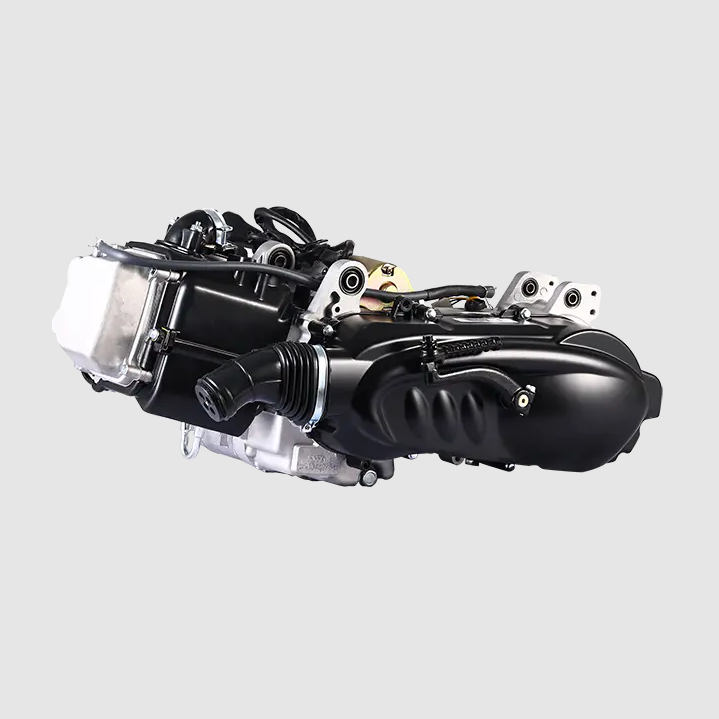
Introduction to Displacement and Acceleration
The question of how engine displacement affects acceleration is central for engineers, manufacturers, and users evaluating performance differences in models produced by a Scooter Engine Factory. Displacement represents the total volume swept by all pistons inside the engine during one complete cycle. In practical terms, it functions as one of the most direct indicators of the engine’s potential for power generation. Larger displacement generally means the engine can burn more air–fuel mixture per cycle, producing greater torque at low and mid-range speeds. This torque becomes a critical factor in acceleration, especially from a standstill or at lower velocities. By examining the mechanical principles behind displacement and the real-world results they produce, one can better understand why scooters of different engine sizes behave so differently in daily transportation scenarios.
Torque Output and Initial Acceleration
Torque is the fundamental force that allows a scooter to overcome inertia and begin moving. Smaller displacement engines, such as 50cc units, generate limited torque due to the small combustion chamber volume, which restricts the amount of fuel burned per cycle. As a result, scooters with low displacement tend to experience slower takeoff speeds and require more time to achieve useful momentum. In contrast, engines in the 125cc to 200cc range deliver significantly higher torque, allowing much quicker acceleration from a stop. This becomes especially noticeable when climbing inclines or carrying additional weight, as larger displacement engines maintain stronger rotational force. For many users choosing between different scooter models, this difference in low-end torque is one of the most influential factors in perceived performance.
Power Generation Across the RPM Range
While torque plays a significant role in initial acceleration, power output becomes increasingly important as speed builds. Power is a product of both torque and engine speed, meaning scooters with larger displacement often enjoy broader power bands. A model manufactured by a Scooter Engine Factory with 150cc displacement can generally maintain stronger acceleration even at higher speeds compared to a 50cc engine, whose torque drops off rapidly as RPM increases. This difference defines how quickly a scooter can perform mid-range overtaking maneuvers or climb to its maximum speed. The increased ability to sustain torque at elevated RPM enables larger displacement scooters to deliver smoother and more responsive acceleration throughout the entire speed range.
Fuel Consumption and Efficiency Considerations
Although larger displacement provides better acceleration, it often comes with trade-offs in fuel consumption. Bigger engines require more fuel to generate power, and although modern engineering can mitigate some of these effects, the fundamental relationship remains. Users prioritizing acceleration may prefer a larger engine, while those focused on efficiency might select a smaller displacement even if acceleration is reduced. A balanced approach is common in the 125cc range, offering acceptable acceleration while maintaining reasonable fuel economy. For a Scooter Engine Factory, designing engines that optimize combustion efficiency across multiple displacement classes becomes essential for meeting diverse market requirements.
Impact of Weight and Transmission Design
Displacement alone does not determine acceleration performance. The overall design—including scooter weight, transmission tuning, and variator configuration—plays a vital role. Even a well-designed 150cc engine may feel sluggish if paired with poor transmission ratios, while a finely tuned 125cc motor could feel exceptionally responsive. Manufacturers often calibrate continuously variable transmissions to complement the torque curve of the engine. This ensures that the scooter stays within its optimal RPM range during acceleration. As a result, two engines with the same displacement can display noticeably different acceleration profiles based on design choices made by the engineering team.
Conclusion
Engine displacement has a substantial and predictable impact on scooter acceleration. Larger displacement engines deliver stronger torque, smoother mid-range power, and faster response, while smaller engines prioritize efficiency at the cost of acceleration. Understanding these dynamics helps manufacturers create engines that meet a variety of performance expectations and allows riders to make informed decisions based on their transportation needs.
Nominal displacement:50ml
Displacement:49.4ml
Bore:39mm
Stroke:41.4mm
Compression ratio:10.5:1
Maximum power:2.7kw/7000r/min
Maximum torque:3.2N·m/5500r/min
Maximin fuel comsumption:≤367g/kW·h
Minimum stable idle speed:1700±100r/min

 English
 Arabic
 French
 Spanish
 Portuguese
 Deutsch
 Turkish
 Dutch
Dutch
 Russian
 Romaian
 Portuguese (Brazil)
 Greek
Greek