


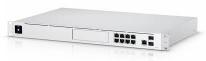
In the architecture of a modern business network, the core switch is the central nervous system. It’s the critical hub that dictates performance, security, and scalability. For businesses outgrowing basic hardware, selecting the right switch is a pivotal decision that impacts every digital operation. The Ubiquiti USW-PRO-48-POE stands out as a formidable contender in this space, offering a rare blend of enterprise-grade power and the streamlined management UniFi is known for. This guide goes beyond a simple spec sheet to provide a comprehensive analysis of the USW-PRO-48-POE, detailing its technical capabilities and, more importantly, the tangible business benefits it delivers. Whether you're managing a large office, a campus, or a sophisticated security system, this article will help you understand why this switch might be the cornerstone your network needs.
Understanding the USW-PRO-48-POE: More Than Just a Switch
The Ubiquiti USW-PRO-48-POE is a 48-port Layer 3 managed Gigabit Ethernet switch designed for professional and enterprise deployments. It consolidates three critical network functions into a single, 1U rack-mounted unit: high-density switching, advanced routing, and high-wattage Power over Ethernet (PoE) distribution. As a core component of the UniFi ecosystem, it is managed through the unified UniFi Network Application, providing a holistic view and control panel for your entire network infrastructure—from wireless access points to security gateways. This integration is key to its value proposition, simplifying complex network management without sacrificing power or flexibility.
Comprehensive Technical Specifications Breakdown
To truly appreciate its capability, let's dissect its hardware and technical specifications in detail.
-
Port Configuration and Speed: The switch is equipped with 48 Gigabit Ethernet RJ45 ports (10/100/1000 Mbps) for connecting wired devices like computers, printers, and servers. Crucially, it also features 4 SFP+ ports. These ports support 1/10 Gigabit fiber or DAC connections, providing high-speed uplinks to other switches, storage arrays, or your core router, ensuring the network backbone never becomes a bottleneck.
-
Power over Ethernet (PoE) Capabilities: This is a defining feature. All 48 RJ45 ports are PoE-enabled. They automatically detect and support both the 802.3at PoE+ and 802.3af PoE standards. The total power budget is a massive 720W, with a maximum of 60W per port (using 802.3bt PoE++ with a compatible adapter). This allows it to power dozens of high-demand devices simultaneously, such as next-generation Wi-Fi 6/6E access points, PTZ security cameras, VoIP phone systems, and access control readers, eliminating the need for messy external power injectors.
-
Layer 3 Switching and Hardware Offloading: Unlike standard Layer 2 switches, this "Pro" model supports advanced Layer 3 routing functions like inter-VLAN routing, static routing, and policy-based routing. Crucially, these functions are hardware-offloaded, meaning they are processed at wire speed without impacting the switch's overall performance. This allows for efficient traffic management between different network segments without pushing everything through a central router.
-
Redundancy and Reliability Features: Built for mission-critical environments, the switch supports dual power supply operation. An optional redundant power supply (RPS) can be installed to provide instant failover if the primary unit fails, a vital feature for maximizing uptime. Its solid metal construction and fanless design ensure silent, durable operation.
The Strategic Business Benefits of Deploying This Switch
The specifications translate into real-world advantages that directly impact a business's operations and bottom line.
-
Unmatched Scalability for Growth: The combination of 48 PoE ports and a 720W power budget provides immense headroom. You can deploy a vast ecosystem of connected devices—across multiple floors or buildings—without worrying about needing an additional switch or exceeding power capacity. The 10G SFP+ uplinks future-proof your investment, ensuring your infrastructure can handle increased data loads for years to come.
-
Enhanced Security Through Segmentation: The integrated Layer 3 capabilities allow for effortless creation and management of VLANs (Virtual Local Area Networks). You can logically isolate sensitive departments (e.g., HR, Finance), guest Wi-Fi traffic, IoT devices, and surveillance cameras onto separate networks. This containment strategy significantly enhances security by preventing lateral movement in case of a breach and improves network performance by reducing unnecessary broadcast traffic.
-
Operational Efficiency and Centralized Management: The UniFi Controller's single-pane-of-glass management is a game-changer. It provides complete visibility into network health, client activity, and power consumption. IT administrators can configure the entire network, apply updates, and troubleshoot issues from a single interface, drastically reducing management overhead and simplifying complex tasks.
-
Professional Reliability and Uptime: Features like redundant power supply support and comprehensive environmental monitoring ensure the network infrastructure remains online and predictable. This reliability supports core business functions, protects revenue, and maintains productivity by minimizing costly network downtime.
Ideal Use Cases and Deployment Scenarios
The USW-PRO-48-POE is purpose-built for environments where its robust feature set is a necessity, not a luxury.
-
Large Enterprise Offices: To power and connect a high density of devices across multiple departments and floors, ensuring seamless connectivity and security.
-
Educational Institutions and Campuses: Perfect for lecture halls, computer labs, and libraries that require reliable, high-bandwidth connectivity for students and staff and power for extensive wireless coverage and security systems.
-
Healthcare Facilities: Supports a critical network of medical devices, staff computers, phones, and security systems where 100% uptime and secure segmentation of patient data are paramount.
-
Advanced Surveillance Deployments: Can serve as the core for a large-scale security system, powering dozens of high-resolution, pan-tilt-zoom (PTZ) cameras and recording servers without breaking a sweat.
Why Professional Installation and Design Matter
While the hardware is powerful, its effectiveness is maximized through expert design and implementation. Properly planning VLAN architectures, calculating PoE budgets, configuring Layer 3 routes, and ensuring optimal physical installation are not simple DIY tasks. This is where engaging with a certified professional partner becomes a critical success factor. At The Insight Solutions, we are your trusted technology consultants. We are a team of certified networking professionals with deep, practical expertise in the entire Ubiquiti UniFi platform. We understand the unique challenges faced by businesses in uk and provide end-to-end professional services—from initial consultation and structured design to flawless installation and ongoing managed support. We don't just provide equipment; we deliver tailored, reliable, and high-performance network solutions that drive business growth.
Frequently Asked Questions (FAQs)
1. Can the USW-PRO-48-POE power the Ubiquiti Access Point U6-Enterprise?
Absolutely. The U6-Enterprise access point requires 802.3at PoE+ (which provides up to 30W), and the USW-PRO-48-POE fully supports this standard on all 48 ports. With its 720W total budget, it can power many of these high-performance access points simultaneously, along with other PoE devices.
2. What is the real-world advantage of Layer 3 hardware offloading?
The primary advantage is efficiency and performance. By allowing the switch to handle routing between VLANs internally at wire speed, you reduce the load on your main network gateway or router. This decreases latency for cross-VLAN traffic (e.g., from a computer in the Sales VLAN to a server in the Data VLAN) and frees up your gateway's resources for other critical tasks like firewall processing and IDS/IPS.
3. How does the redundant power supply (RPS) work, and is it necessary?
The RPS is an external unit that connects to the switch. If the switch's internal power supply fails, the RPS automatically and instantly takes over without any interruption to network operation. While not necessary for all deployments, it is considered essential for mission-critical environments where even a brief network outage would result in significant financial loss or operational disruption.
4. Is this switch overkill for a small or medium-sized business?
It depends on the business's needs and growth trajectory. For a typical small office with under 20 users, it likely is. However, for a medium-sized business with a large number of PoE devices (like 30+ cameras and access points), plans for rapid expansion, or a need for advanced security segmentation, it represents a solid, future-proof investment that will serve as a network foundation for years.
5. Does configuring the Layer 3 features require a complex CLI (Command Line Interface)?
No, and this is a significant benefit of the UniFi ecosystem. While advanced options are available via CLI, all fundamental Layer 3 features—including inter-VLAN routing and static routes—can be configured easily through the graphical user interface (GUI) of the UniFi Network Application. This makes advanced networking more accessible to administrators without deep CLI expertise.

 Arabic
 French
 Spanish
 Portuguese
 Deutsch
 Turkish
 Dutch
Dutch
 Italiano
 Russian
 Romaian
 Portuguese (Brazil)
 Greek
Greek